Data Centre HVAC Australia for Reliable Critical Facilities
At Hewitt Engineers, we provide practical engineering solutions for critical facilities across Australia. Our team delivers coordinated building services design, including mechanical HVAC systems, electrical infrastructure, hydraulic services, and fire protection. These integrated capabilities allow us to support data centre projects from concept through to delivery. Learn more about our full range of engineering capabilities on our services and our projects page.
The physical environment inside a data centre is just as important as the IT equipment installed within it. Servers, batteries, network hardware, and power systems all generate heat and require controlled operating conditions. Without reliable cooling and airflow management, even a short failure can cause downtime, equipment alarms, or expensive service interruptions. That is why professional Data Center HVAC Australia design is a critical investment.
Why Data Centre Air Condition Design Matters
A common misunderstanding is that a data centre only needs “strong air conditioning.” In reality, cooling for a critical facility is far more complex than a standard office HVAC system. Data rooms experience constant internal heat loads, often operating 24 hours a day with little variation.
A properly designed data centre air condition system controls room temperature, supports equipment performance, and reduces the chance of unexpected shutdowns. Stable temperatures can also improve equipment life expectancy by reducing thermal stress on processors, drives, and power supplies.
In many existing facilities, cooling issues are caused not by lack of capacity, but by poor distribution of conditioned air. Some racks receive too much cooling while others overheat. Good design solves both capacity and airflow performance together.
Benefits of an effective system include:
- Reduced overheating risk
- Improved equipment lifespan
- Lower maintenance issues
- Better operating stability
- Improved energy efficiency
- Easier future expansion planning
Why Data Centre Airflow Management Is Equally Important
Even the best cooling equipment will underperform if airflow inside the room is poorly managed. Many facilities have enough installed cooling capacity, yet still experience hotspots because cool air is bypassing equipment or hot air is recirculating back into server intakes.
Professional data centre airflow management design focuses on moving air efficiently through the room. The goal is to deliver conditioned air directly to equipment inlets while removing hot exhaust air in a controlled manner.
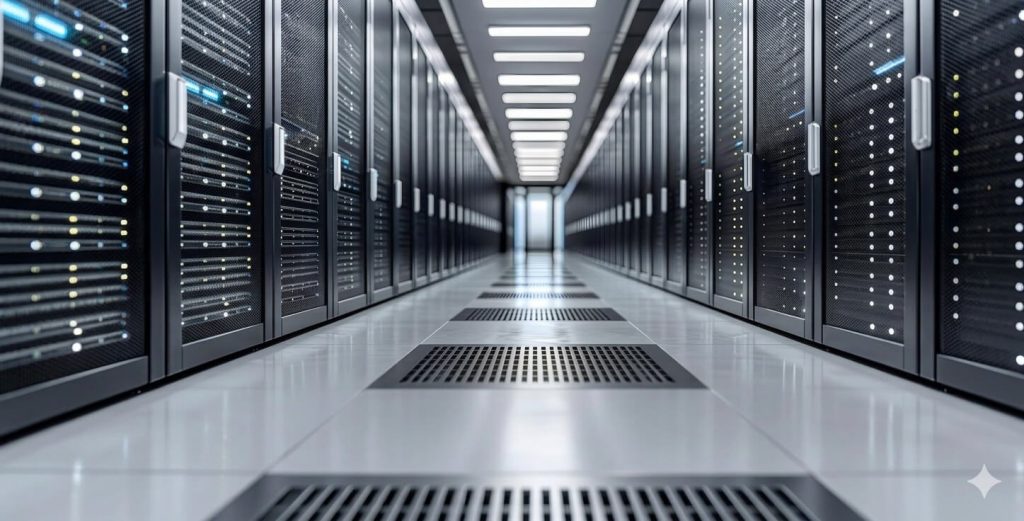
Depending on the facility layout, this may include raised floor supply systems, overhead ductwork, ceiling return air paths, aisle containment systems, and pressure balancing between adjacent rooms. Correct airflow management planning often delivers major improvements without increasing plant size.
Well-designed airflow management also reduces wasted fan energy and creates more consistent conditions across the room, especially in high-density rack environments.
Typical solutions include:
- Hot aisle / cold aisle containment
- Raised floor supply air
- Overhead ducted systems
- Return air management
- Rack layout coordination
- Pressure balancing strategies
Standards Used for Data Centre HVAC Australia Projects
Critical facilities should be designed in line with recognised standards and operational benchmarks. Data centre HVAC systems require more rigorous planning than standard commercial buildings because reliability, resilience, and continuous operation are central to project success.
Depending on the project type, our designs may reference Australian and international guidelines such as ASHRAE Thermal Guidelines for Data Processing Environments, the National Construction Code (NCC), relevant Australian Standards, and energy frameworks such as NABERS (National Australian Built Environment Rating System).
We also consider client-specific performance targets including redundancy levels, future growth allowances, maintenance access, and energy efficiency objectives. For example, some facilities require N+1 redundancy, while larger operations may request 2N resilience for critical systems.
Using recognised standards helps establish clear design criteria for temperature ranges, humidity control, airflow rates, filtration levels, and maintainability.
Environmental Control and Moisture Management
Stable environmental conditions are important in data centres to support reliable equipment operation. While temperature control is usually the main priority, moisture levels should also be managed to reduce condensation risk and maintain system performance.
Most modern facilities achieve this through precision cooling systems, controlled airflow, and continuous monitoring rather than dedicated humidification systems.
Typical design considerations include:
- Temperature stability
- Dew point control
- Condensation risk management
- Precision cooling controls
- Continuous monitoring
- BMS (Building Management System) integration
Filtration and Air Quality for Sensitive Equipment
Air quality is another important factor in critical environments. Dust and airborne contaminants can accumulate on electronic equipment, reduce heat transfer efficiency, and increase maintenance requirements over time.
Poor filtration can also affect cooling coils and fan systems, reducing overall HVAC performance. For this reason, filtration should be considered as part of the total mechanical design rather than an afterthought.
Depending on the site location and risk profile, systems may include pre-filters, fine filters, or higher-efficiency solutions. Positive pressure strategies can also help reduce uncontrolled dust infiltration from surrounding areas.
Routine maintenance access is equally important. Even the best filters must be replaced regularly to maintain airflow and efficiency.
Typical measures include:
- Pre-filters for larger particles
- Fine filters for dust control
- High-efficiency filtration where required
- Positive pressure room design
- Safe access for maintenance
“In data centres, cooling is not about comfort, it is about maintaining continuous operation and protecting critical infrastructure”
— Hewitt Consulting Engineers
Our Mechanical HVAC Design Services
Every data centre has different priorities. Some clients need a compact server room for a commercial office, while others require scalable infrastructure for large mission-critical operations. Our role is to develop solutions that suit both immediate needs and future growth.
We provide mechanical HVAC design that balances performance, efficiency, maintainability, and project budget.
- Cooling Systems
We design a range of systems including CRAC (Computer Room Air Conditioning) units, CRAH (Computer Room Air Handling) systems, chilled water solutions, direct expansion systems, in-row cooling units, and rear door heat exchangers. Equipment selection depends on available space, redundancy needs, heat density, and operating strategy.
- Central Plant
For larger facilities, we provide chiller plant design, cooling towers, pump systems, duty/standby arrangements, and future capacity allowances. Plant rooms are planned for serviceability, efficiency, and staged expansion.
- Energy Optimisation
Energy use is a major operational cost in data centres. Where appropriate, we review free cooling opportunities, variable speed drives, smart controls, load-based staging, and heat recovery strategies to improve long-term efficiency.
- Integrated Electrical, Hydraulic and Fire Services
Reliable HVAC performance depends on strong coordination with other building services. A cooling system cannot function properly without dependable power, hydraulic infrastructure, and fire protection measures.
Our integrated design approach improves constructability and reduces clashes during installation.
- Electrical Services
We provide high and low voltage distribution, UPS coordination, generator integration, monitoring systems, emergency power, and controls infrastructure to support critical HVAC equipment.
- Hydraulic Services
Our hydraulic scope may include chilled water pipework, drainage systems, water services, stormwater coordination, and associated plant connections.
- Fire Protection Services
We also design sprinkler systems, smoke detection, heat detection, emergency warning systems, and smoke control solutions in line with compliance requirements.
Why Clients Choose Hewitt Engineers
Clients choose Hewitt Engineers because we understand that critical facilities need practical solutions that work in the real world. Good documentation is important, but reliable operation, service access, efficiency, and coordination are what truly determine project success.
Our team combines technical engineering capability with practical project delivery knowledge. We focus on systems that can be built, maintained, and expanded as client needs grow.
Clients value us for:
- Strong HVAC engineering expertise
- Practical data centre air condition solutions
- Efficient data centre ventilation strategies
- Compliance-focused documentation
- Upgrade and retrofit capability
- Energy-conscious design outcomes
- Coordinated multidisciplinary delivery
Upgrade Existing Data Centres
Many existing facilities were designed for lower IT loads than what is required today. Rack densities have increased, uptime expectations are higher, and energy efficiency is under greater scrutiny.
We assist clients with targeted upgrades that improve performance without unnecessary disruption. In many cases, smart improvements can extend the life of existing infrastructure and avoid complete replacement.
Typical upgrade works include:
- Cooling capacity increases
- Airflow corrections
- Redundancy improvements
- Controls modernisation
- Plant replacement
- Energy reduction strategies
Speak With Experts in Data Centre HVAC Australia
Whether you are planning a new data centre, expanding a server room, or investigating performance issues in an existing facility, Hewitt Engineers can assist with practical and reliable engineering solutions.
We deliver complete Data Center HVAC Australia services including cooling, ventilation, humidity control, filtration, electrical coordination, hydraulic systems, and fire protection design.
Frequently Asked Questions:
Data centre HVAC is designed for continuous operation, precise temperature control, and high heat loads from IT equipment, unlike standard systems which focus on occupant comfort.
Common systems include CRAC units, CRAH systems, chilled water plants, and in-row cooling solutions depending on the size and redundancy requirements of the facility.
Humidity control helps reduce condensation risk and supports stable operating conditions for sensitive electronic equipment, especially in variable climates.
Proper airflow management ensures cold air reaches equipment inlets efficiently and hot air is removed without recirculation, reducing energy waste and preventing overheating risks.